There's a full-scale model of Sputnik-1 inside the former National Guard armory on Culver Boulevard, and it will be there for almost a year. "Competing Cosmologies: Interpreting the Sky" opens at the Wende Museum this Saturday, November 7, and runs through October 17, 2027. You don't need to rush for the satellite. The programs around it are another matter. Each one in November happens on a single date, and three of the six fall on a weeknight evening or a Monday, when the museum's posted hours say the building is closed.
The Wende's posted public hours are Friday through Sunday, 10 a.m. to 5 p.m. It is closed Monday and Tuesday, and Wednesday and Thursday are for school tours only. The November calendar is busier than that schedule suggests.
The Wende's visit page says the galleries are closed for an exhibition changeover until Saturday, November 7. Opening day runs from noon to 5 p.m. A curator-led tour starts at noon, speeches follow at 2 p.m., and a reception begins at 3 p.m. The museum offers a free RSVP for the opening through its event page.
The show was co-curated by the Wende's chief curator Joes Segal, associate curator Emma Diffley and NASA historian Lois Rosson, as Culver City Crossroads reported when the opening was announced. The question behind it fits a museum built around Cold War history. Crossroads frames it as "What did the space age mean to the artists who watched it happen, and how did they contribute to it?"
According to the exhibition page, the galleries are organized in four sections: Astronomy, the Space Race, Futurisms and Aliens. The work comes from artists in the East, the West and the Global South. Besides the Sputnik-1 model, the objects include an original meteorite and cosmos-themed sculptures. The artist list is unusual. It includes the space painter Chesley Bonestell, the cosmonaut Alexei Leonov, the musician Sun Ra, Lia Halloran, Chitra Ganesh, Beatriz Cortez, Jitish Kallat, Paul Laffoley, Mark Steven Greenfield, Ionel Talpazan, Fedir Tetyanych and Li Tianbing, whose 2020 oil painting "The Great Escape" appears in the museum's preview.
One curator has a local connection. The Wende's event page says Rosson's current book project traces how Los Angeles's art and special effects industry shaped the look of space in planetary science and popular culture. In a city that has hosted studios for more than a century, an exhibition about how artists pictured space before and alongside the scientists fits comfortably.
The exhibition can wait until a slow Sunday in spring. These dates won't come back. All of them come from the Wende's events calendar and individual event pages, and the museum says admission to exhibitions and public programs is free.
Set the times against the posted hours. The two Friday programs start at 6 and 7 p.m., after the 5 p.m. close, and the film night falls on a Monday, when the museum is normally closed. Anyone who only stops by during regular weekend hours will see the Sputnik and miss half the month.
The Nov. 21 panel has the clearest link to the exhibition and the most famous speaker. The Wende presents it with the History of Science Society. It brings together Nobel laureate and astrophysicist Kip Thorne, artist Lia Halloran and co-curator Lois Rosson, moderated by History of Science Society president Soraya de Chadarevian and Joes Segal.
According to the event page, Thorne shared the 2017 Nobel Prize in Physics for contributions to the LIGO detector and the observation of gravitational waves, and he was a scientific consultant on Christopher Nolan's "Interstellar" and "Tenet." Halloran is one of the artists in "Competing Cosmologies." She has also collaborated with Thorne on a book, "The Warped Side of Our Universe." That afternoon, an artist from the exhibition will be in the room with the physicist she worked alongside.
The page also includes the museum's own warning about attendance:
"Seating is first come, first served. An RSVP does not guarantee admission once capacity is reached. No late entry."
The same note says the panel takes place during open hours. Guests check in at the front of the museum, the garden side gate opens 30 minutes before the 2 p.m. start for ADA access and check-in, and theater doors open 15 minutes before. For a free talk with a Nobel laureate in a Culver City museum, arriving early is the only reliable way to get a seat.
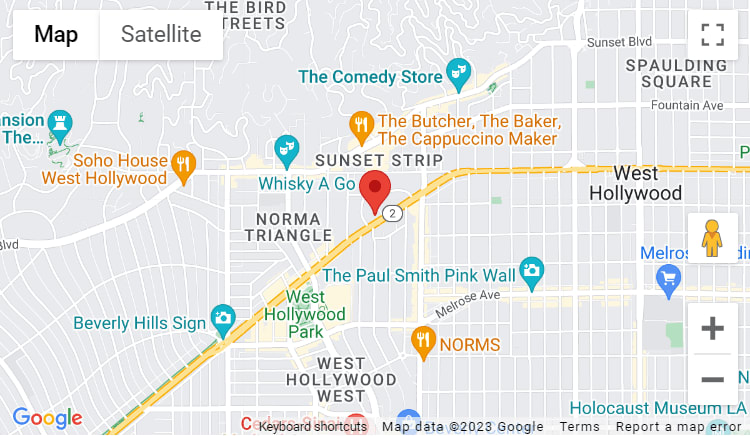
The building makes the visit simple, though it has one rule that catches people. The Wende sits at 10808 Culver Blvd., near the corner of Culver Boulevard and Overland Avenue, and Culver City bus lines 3 and 7 serve it.
That last caveat matters most in November, which has the heaviest weekend program schedule of the season.
The building has its own history. The Los Angeles Times described the armory as built in 1949 and as an atomic-bomb shelter as well as a former Guard facility. A space-race exhibition now fills a building put up during the same Cold War. The Wende's own materials describe the campus as galleries, gardens and a community center. They also say an East German guardhouse is on permanent loan in the sculpture garden.
Once the one-time programs are over, the museum is still worth a return visit. The Wende, founded in 2002, says its collection holds more than 200,000 artworks, objects and archival materials, and that it serves more than 30,000 visitors a year through free admission and programs with no barriers to entry.
A second exhibition is already open alongside the new one. "Between Two Empires: Argentina in the Cold War Pendulum (1945–1989)," guest-curated by Inés Marseillan, runs through January 31, 2027, and draws on photographs from the archives of the Argentine newspapers La Razón and Clarín. Because it closes about nine months before "Competing Cosmologies," this winter is the only time to see both in one visit.
December's calendar is shorter. It lists "Call It Evil," a conversation between Susan Neiman and Paul Holdengräber, on Sunday, Dec. 6; picture-book workshops with Stephanie Lunkewitz on Sunday, Dec. 13; and another bilingual Russian-English storytime on Saturday, Dec. 19. The Wende also runs ongoing community programs, including Community Flow Yoga, Wellness Wednesday, writing groups and a Tuesday Men's Club. The building is busy even on days the galleries are closed.
The Sputnik model will still be on Culver Boulevard next October. The Diwali concert, the Faliks evening, the Thorne panel and the Rabin film night each happen once this month.
At Davis + Burns Group, part of following Culver City closely is keeping track of places like the Wende, where a free afternoon can include a Nobel laureate. If you'd like to talk about the parts of the Westside that sit within an easy walk or ride of Culver and Overland, we'd be glad to hear from you. Work With Us.
Our expansive network and white-glove service ensure a bespoke experience for both buyers and sellers. Let our top producing team find your dream home today.
Contact Today